Rami's Blog

Like the Yin-Yang, Eastern Martial Arts and Western medicine are two halves of a whole. My mission is to preserve the ancient mind-body tools and pass them on to you.


Dealing with Sciatica

Pain that shoots up or down the leg and into the lower back can be caused by a few different things, and the first step in treating this kind of pain is understanding where it's coming from.

One possible cause of this leg and back pain is an issue with your Sacroiliac Joint. SI joint issues are often mistaken for lower back injuries or sciatica. They can occur due to age, posture, lifestyle, and are more common in women.

Another cause of this pain is sciatica. Instead of being caused by improper functioning of a joint, sciatica is usually the result of a herniated disc, or other spinal issue. The disc or soft tissues pinch the nerve roots in the lower back , which send pain singles down the sciatic nerve and into the legs.

The pain from sciatica can range from hardly noticeable to incapacitating. When it gets bad, doctors will often suggest cortisone injections. But this fix is only temporary.

If you want to prevent sciatica, or treat your current sciatic pain and prevent reoccurrence, follow this mind-body exercise routine, similar to the one for SI Joint pain:

  1. Calf Stretch: Remember to utilize 60% effort, less is often more with joint and nerve issues
  2. Vitamin H: Do whichever hamstring stretch works best for you. The video shows a few ways to safely stretch your hamstrings if you back is giving you problems.
  3. Chair Twist: Again, go only to between 60% and 80% effort. 
  4. Outer Hip Stretch: Can be done on a chair, or on the ground. (Video coming Tuesday!)
  5. Groin Stretch: You can use a chair or a machine, like I show in the video.

Remember, meditation is a huge part of healing and relaxation. Pairing your physical exercises with breathing patterns and Tai Chi forms will only improve your results. Consider combining this exercise with my Sunrise Tai Chi form, visualizing the energy from the sun flowing through your body, into the SI Joint or Sciatic Nerve, and then down into the Earth, dissolves the pain like a river eroding a stone.

Yin and Yang in Meditation

There are, generally speaking, two kinds of meditation: passive meditation, and active meditation.

Passive meditation would be something like Zen meditation. The goal of Zen is to sit quietly and do nothing. Have no thoughts, and simply accept the sensations in your body and the state of the world around you without judgment.

Active meditation includes Taoist visualizations. You may look like you are sitting and doing nothing, but on the inside you are actively picturing the movement of energy through your body, around your body, and in the world outside. Active meditation is about willpower, and your ability to maintain focus on one thing for an extended period of time.

Both kinds of meditation are important for a healthy mind, just like both strength and flexibility are important for a healthy body. To function at 100% during the day, your mind needs to be clear. Clear of worry when you are just resting (passive meditation), and clear of distractions when you are working (active meditation). 

When it comes to sticking to your mind-body routine, both acceptance and willpower are needed. You need the willpower to get up off the couch, put down the potato chips, and do those workouts. But you also need acceptance and patience for when you don't do your workout, so you aren't beating yourself up about missing a day and giving yourself unhelpful stress.

Think about which side of the meditation balance you need to work on, and how your life, or the lives of people around you, might be different if you could do both equally well.

The Energy Centers Meditation Routine

Some time last year we began a series of posts about meditating while visualizing your lower and upper energy centers, your energetic baton, and the energetic bubble. This will be the capstone post for the series, where we put everything together, finish up the energetic bubble,  and give you a routine for practicing that you can do in less than half an hour.


The Energy Centers Meditation Routine

1. The Lower Energy Center: Sit down comfortably on the edge of a chair. Touch your tongue to the roof of your mouth and begin to visualize a glowing ball, a little smaller than your fist, sitting two inches below your naval, and two inches back from the skin, toward your spine. If it helps, picture this energy center like a calm pool of clear water. Do this for about 5 minutes and then move on.

2. The Upper Energy Center: While still visualizing the lower energy center, begin to visualize the upper energy center as well. This center is located in the middle of the brain, halfway in between the base of the skull and the nose. Don't focus on your forehead, because that is a different visualization. Instead, try being aware of the sensation of your soft palate. That should get you a lot closer. The upper center can also be visualized like a pool of water. Make sure you picture this pool on higher ground than the lower energy center. Continue these two visualizations for 5 minutes.

3: The Energetic Baton: Now it is time to connect the two visualizations into one, and cool the baton. Picture the upper energy center flowing down into the lower energy center, like a waterfall, or a stream down a hill. Focus on the sensation of moving energy from your head and shoulder girdle down to your lower abdomen. You should feel a cooling sensation as your energy settles and your brain quiets down a little. Spend another 5 minutes here.

4: The Energetic Bubble: Lastly, begin expanding your focus to just beyond the surface of your skin, about two inches, into a bubble. This bubble is your filter to pull in good energy from the world around you, and also is a shield, to protect you from negative energies. Remember that the energetic bubble reacts to the temperature around you: the colder it is, the more the bubble shrinks toward your core, the warmer it is, the more the bubble grows outward into the air. Your goal here is to visualize the bubble, identify what parts of it are weaker than others, and then visualize yourself patching those weak areas. After another 5 minutes here, you have completed your energy centers meditation routine!

And there you have it! Do this routine every other day and you will begin feeling more balanced, calm, and your energy bubble might even keep those pesky mosquitoes away! (Just kidding, but one can wish!)

Happy stretching!

The Simple Way to Breath Through All Four Gates

Here is the link to the upper two gates by themselves, and here is the link to the lower two gates by themselves.

Now let's put it all together.

Once you are comfortable with each of the two gates, it is time for you to put all four gates together. Stand with your feet shoulder-width apart, palms facing down in front of your body about two inches below your navel. The elbows should be a fist away from the trunk. With the next inhalation, bring your mind from the four gates into the lower energy center. On the exhalation, shift your mind into the four gates. Make sure that your focus is even at all four gates.

You will notice that two of the four gates are sometimes stronger than the others. Certain people may sense the bottom two gates more strongly, and others may sense the upper two more strongly. What needs to be done is to balance the sensation and equalize it between the four gates. Move your mind more intensely into the two gates that you feel less sensation in. Eventually, you will be able to balance the four gates.

In late blogs, I will detail how to visualize the energy moving along a particular path from the gates to the energy center. But for now, practice this technique the simplified way and let me know how it works for you.

Happy meditating!

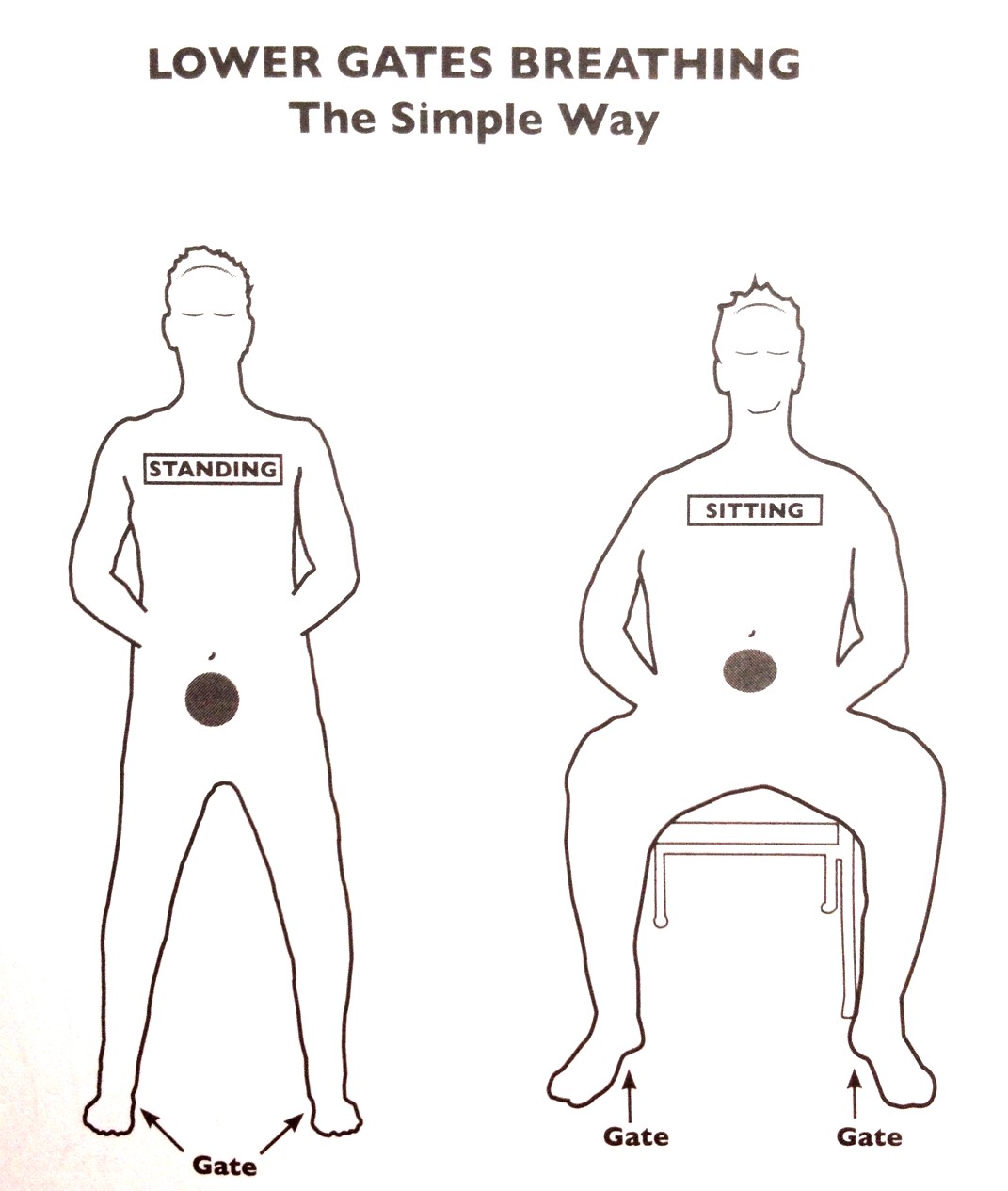
Simple Breathing Through the Lower Two Gates

[See Upper Two Gates first, here]

After training the two upper gates for a while, place your palms on your center of gravity (lower energy center), and practice sending energy to the lower two gates. Inhale with your mind in the lower energy center. As you exhale, put your mind a few inches below the soles of your feet. Distribute the weight between the ball of the foot and the heel. 

Inhale, bring your mind into the lower energy center, exhale, put your mind and inch or two beyond the soles of your feet.

Continue with this process until you feel comfortable with the mind shifting from the lower energy center to the lower two gates, and then back again.


P.S. The dates and deadlines for my new meditation workshops at Yang's Fitness Center in Andover have been extended, so check out their new page about it and how to register. Here, and here, you can find the updated flyers.

Happy stretching!